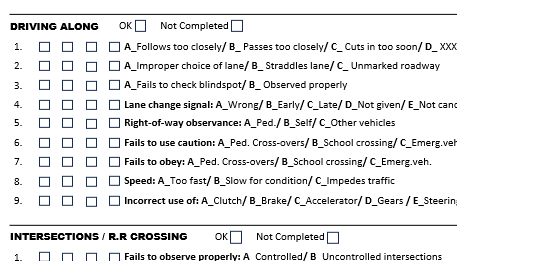
G and G2 Road Test Marking Sheets
G Road Test Marking Sheet
Crack the Code: Your Guide to the Examiner's Marking Sheet. Drive confidently with a breakdown of what to expect on your road test. Ready for success on your terms!
G Road Test - Marking Sheet Explanations
Turns - Left and Right Turns
- Approach -
Before slowing down to make a turn, it’s important for the driver to check the traffic in front and behind. If changing lanes, the driver needs to check the blind spot related to the direction of the change.
Before slowing down to make a turn, it’s important for the driver to check the traffic in front and behind. If changing lanes, the driver needs to check the blind spot related to the direction of the change.
The driver should turn on the signal before slowing down for the turn, unless there are cars waiting to join the road from side streets or entrances before the turn. If there are such cars, the driver should wait until passing these entrances before turning on the signal. This avoids confusion that the driver might turn into a side entrance instead of going to the intersection.
While slowing down, the driver should keep at least a 2 to 3 second gap behind any car in front.
- If Stop -
The driver needs to make sure the car comes to a complete stop, without rolling forward or backward. If a traffic light changes or if they have to let other cars go and they end up over the stop line, they shouldn’t reverse to get behind the line. They should only start moving when it’s safe to check for other cars or people walking on the street they’re turning onto, or to start the turn.
If the driver has to stop behind another car at the intersection, they should stop far enough back so they can go around the car in front without having to reverse. This is good for three reasons: it makes it easier to go around the car in front if it breaks down, it stops them from being pushed into the car in front if they get hit from behind, and it stops them from crashing into the car in front if it rolls back or reverses. If the driver’s car is the first one at a stop intersection, they should stop behind the stop line. If there’s no stop line, they should stop where a stop line would usually be painted, or behind the edge of the intersection as defined in the Ontario Highway Traffic Act. While waiting to make a left turn, the driver should keep the front wheels pointing straight ahead. This stops the driver’s car from being pushed into the lane for cars coming the other way if it gets hit from behind. On a right turn, the driver should keep the wheels straight if there’s a chance of being pushed into people walking across the street they’re turning onto. At a big intersection with curved sidewalks, the car can be angled to follow the curb, which helps block other cars.
None while waiting If the driver has to stop and wait for a traffic light or other cars before starting, they should keep checking the traffic all around while they’re waiting.
- Turning -
Right before making a turn at an intersection, the driver should look left, straight, and right to make sure it’s safe. If they’re not sure who should go first, they should try to make eye contact with other drivers or people walking nearby. If there’s a chance another car might pass them on the left during a left turn or on the right during a right turn, they should check the blind spot on that side before starting the turn. If any other cars or people who have the right-of-way have to avoid their car, then they didn’t check the traffic well enough.
When turning, the driver should keep both hands on the steering wheel. This is when they’re most likely to meet other cars, so they need the best control of their car. If they can’t use both hands because of a disability, that’s okay. If their car has a manual transmission, they shouldn’t change gears while turning. But if their car’s low gear is very high, they can change gears just after they start moving but before they’re in the middle of the turn. They can also change gears in the intersection if it’s very wide (more than four lanes) and not changing gears would slow down other cars too much. Not changing gears keeps their car powered up during the turn, which gives them the best control.
The driver should start moving within 4 – 5 seconds after it’s safe. They should keep a steady speed during the turn, and speed up a little after the middle of the turn. They should go slow enough to keep control of their car, but fast enough so they don’t slow down other cars too much.
The driver should make their turn into the correct lane on the road they’re turning onto. They shouldn’t cross over any lane lines or curbs.
- Complete Turn -
The driver should finish the turn in the same lane they started in. If they’re making a left turn onto a road with multiple lanes and the curb lane is for through traffic, they should move to the curb lane once they’re up to traffic speed and it’s safe. On a right turn, the driver usually moves to the right lane of the road they’re turning onto. But if the closest lane is blocked by parked cars or something else, and the driver would have to change lanes right after turning, they should go straight to the next open lane on the road they’re turning onto.
Once the driver is up to traffic speed, they should check their mirrors to see what the traffic situation is on the road they’ve turned onto.
The driver should speed up to match the speed of the other cars on the road, using enough acceleration to blend in smoothly with the traffic. If there aren’t many cars on the road, they should speed up moderately. They can speed up more if they need to in order to blend in with the traffic on the road they’re turning onto. If their car has a manual transmission, they should change gears to match the speed of the car.
Lane Changes - Business/Expressway
When the driver is trying to change lanes, they should look ahead, check the mirrors, and also check the blind spot that’s relevant to the direction they’re moving in. They should split their attention between looking ahead, checking the mirrors, and checking the blind spot, focusing more on the places where a crash is most likely to happen. If there’s another lane next to the one they’re moving into, they should check the traffic in that lane too. This can help them avoid a crash with another car that’s moving from that far lane into the same lane they’re moving into.
The driver should turn on the signal when there’s a good enough gap to change lanes. After turning on the signal, the driver should wait about as long as it takes to check the blind spot one last time before starting to change lanes. The signal should be on early enough before changing lanes so that a driver behind has time to react to the signal. If there’s a lot of traffic in the lane the driver is trying to move into, the driver can turn on the signal before there’s a big enough gap to change lanes. This lets the drivers behind know that the driver is looking for a gap to change lanes.
The driver should keep a gap of 2 to 3 seconds in front of them both before and after changing lanes. If there’s another lane next to the one they’re moving into, the driver should avoid moving into the blind spot of any car in that far lane.
The driver should adjust their speed to match the traffic in the new lane.
The driver should change lanes with a smooth, gradual movement to the middle of the new lane.
While changing lanes, the driver should keep both hands on the steering wheel.
The driver should turn off the signal as soon as they finish changing lanes.
Business / Residential - Driving Along
In areas with businesses, there are many places where cars or people might enter the road from the side. These places can include entrances to businesses, institutions, construction sites, pedestrian crossings, railway crossings, and more. At these places, the driver should look left and right to check for cars or people that might be about to enter the road.
On residential streets, the driver should watch for activity at school entrances, pedestrian crossings, driveways, sidewalks, and any other places where there might be traffic hazards. On rural roads, the driver should watch for activity at entrances to homes, farms, businesses, and industrial sites. At these places, the driver should look left and right to check for cars or people that might be about to enter the road.
While driving, the driver should check the mirrors every 5 to 10 seconds. If there’s a lot of traffic and cars are moving at different speeds, the driver should check the mirrors even more often.
The driver should choose the lane that’s safest for driving straight ahead. Usually, this is the lane closest to the curb. But if that lane is often blocked by traffic, or there are a lot of hazards near the curb, the middle lane might be a better choice. When in a lane, the driver should stay in the middle of the lane and avoid drifting over the lane lines. To keep in the best lane, the driver should look ahead (12 to 15 seconds) and change lanes to avoid potential hazards and obstructions.
The driver should stay in the middle of the lane. If there are no lane lines, the driver should stay in the middle of the part of the road that cars drive on. On a wide residential street, the driver should stay toward the middle of the road, away from parked cars or people walking on the sidewalk. If the driver can’t see far ahead because the road bends or goes over a hill, they should adjust their position in the lane to lower the risk of crashing into a car coming the other way that’s over the center line. To stay in the best part of the lane, the driver should look ahead (12 to 15 seconds) and adjust their position in the lane to avoid potential hazards and obstructions.
The driver should avoid going over the speed limit or driving too slowly. They should try to keep a steady speed when they can. The driver should look ahead (12 to 15 seconds) to spot potential hazards and obstructions that they could avoid or be ready for by adjusting their speed.
The driver should always keep at least a 2 to 3 second gap in front of them. If a car is following too closely behind them, the driver should increase the gap in front of them. On a road with multiple lanes, the driver should avoid driving next to other cars or in other drivers’ blind spots. In slow traffic, the driver should avoid following too closely behind big vehicles that block their view of the traffic in front. When stopping behind another car, the driver should stop so they can see the back wheels of the car in front, or far enough back to be able to go around and pass the car in front without having to reverse.
The driver should always keep at least a 2 to 3 second gap in front of them. If a car is following too closely behind them, the driver should increase the gap in front of them or change lanes. In slow traffic, the driver should avoid following too closely behind big vehicles that block their view of the traffic in front. When stopping behind another car, the driver should stop so they can see the back wheels of the car in front, or far enough back to be able to go around and pass the car in front without having to reverse.
Expressway
- Entering -
As soon as you can see the highway traffic from the entrance ramp, start checking your mirrors and blind spots to keep an eye on the traffic behind you. Also, watch the cars ahead of you on the ramp to keep a safe distance. Split your attention between watching ahead, checking your mirrors, and looking over your shoulder, focusing more on where a collision is most likely to happen.
Turn on your turn signal either before or as soon as the highway traffic would be able to see your car on the ramp.
From the moment you enter the ramp until you merge with the highway traffic, keep a gap of at least 2 to 3 seconds from the car in front of you. Time your merge so you don’t end up next to or in the blind spot of any car in the next lane. If the traffic is heavy and/or moving fast, making it hard to keep the ideal spacing, adjust your speed to get the best spacing possible. Stay within the lane boundaries while you’re on the ramp and acceleration lane.
While you’re on the ramp curve, manage your speed so that you don’t feel a strong force pushing you towards the outside of the curve. Start speeding up to match the highway traffic speed once you’re in the acceleration lane. Throughout the merge, control your speed so you can smoothly join the highway traffic.
When merging onto the highway, make a smooth and gradual move to the middle of the highway lane. Avoid any sharp or sudden movements.
Turn off your signal as soon as you’ve successfully merged onto the highway lane.
- Driving Along -
While you’re driving, it’s important to constantly keep an eye on the traffic around you. Make sure to check your mirrors every 5 to 10 seconds.
Avoid going over the speed limit or driving too slowly. Try to maintain a steady speed when you can. Look ahead for about 12 to 15 seconds to spot any potential hazards or obstacles. You can avoid or minimize these by adjusting your speed accordingly.
Always keep a gap of at least 2 to 3 seconds from the car in front of you. If a car is tailgating you, increase the gap in front of you or change lanes. Try to keep space on your sides and avoid driving in other drivers’ blind spots. Avoid following large vehicles too closely as they can block your view of the traffic ahead.
- Exiting -
Before moving to the exit lane, make sure to check both left and right, as well as your mirrors. If there’s a lane on your right (like an entrance ramp acceleration lane) or a paved shoulder that another car could use, don’t forget to check your right blind spot.
Turn on your turn signal before you reach the exit lane. This lets other drivers know your intentions.
Enter the exit lane right at the start of the lane. Make a smooth, gradual move that follows the shape of the exit lane boundary. Stay within the lane markings for the exit lane. If there are multiple exit lanes, don’t cross solid lines to change lanes.
Don’t start slowing down until you’re fully in the exit lane (as long as traffic allows). Slow down at a steady rate. Gradually reduce your speed in the exit lane to avoid causing problems for the traffic behind you. On the ramp curve, manage your speed so you don’t feel a strong force pushing you towards the outside of the curve. If your car has a manual transmission, shift down at the right time based on your speed.
Always keep a gap of at least 2 to 3 seconds from the car in front of you. This gives you enough time to react if the car in front suddenly slows down or stops.
Turn off your turn signal as soon as you’ve moved from the exit lane to the ramp. This lets other drivers know that you’ve completed your lane change.
Helllo
- Curve -
When you’re approaching a curve, look for signs or clues that indicate the safe speed to take the curve. These clues could be a posted speed limit sign, the shape of the curve from your perspective, and the type of road you’re on. Slow down to the safe speed for the curve before you’re more than about 30 metres into the curve. If the curve is blind, meaning you can’t see all the way around it, slow down even more. This reduces the risk from oncoming traffic crossing into your lane, and from the curve being tighter than you expected. Slow down enough before the start of the curve so you don’t have to brake while you’re in the curve. While you’re in the curve, maintain a steady speed to balance the forces pulling you towards the outside and inside of the curve. Near the end of the curve, start speeding up to get back to your normal speed on the straight road. If your car has a manual transmission, don’t change gears while you’re in the curve. This keeps your car powered throughout the curve, prevents your wheels from locking up if you downshift, and gives you maximum control over your power when you need it most.
When you’re getting close to a curve and starting to enter it, try to look as far around the curve as you can. This will help you keep a smooth line around the curve and stay centered in your lane. Avoid focusing too much on the road just in front of your car. If you do, your car might keep drifting back and forth across the curve, and you’ll have to keep correcting your steering.
Stop Intersection
-Approach -
Before you start to slow down as you approach an intersection, make sure to check the traffic in front of and behind you.
When slowing down, apply the brakes steadily to decelerate at a consistent rate. If your vehicle has a manual transmission, you can choose to downshift during deceleration to match the gear with your speed. Avoid coasting with the clutch depressed or the automatic transmission in neutral, unless the conditions are very slippery.
While you’re slowing down, maintain a gap of at least 2 to 3 seconds from the vehicle in front of you. This gives you enough time to react if the vehicle in front suddenly slows down or stops.
- Stopping -
Make sure to come to a complete stop. Once you’ve stopped, don’t let your car roll forward or backward. If a change in the traffic light or having to yield to other traffic leaves you over the limit line, don’t back up. Wait until the traffic conditions, including pedestrians, allow you to either move forward to check for traffic on the intersecting street or to start crossing the intersection.
If you have to stop behind another car at the intersection, stop far enough back so you can pull out and pass without having to back up. This gap serves three purposes. It reduces the risk of having to pull out around the car in front if it stalls. It reduces the risk of being pushed into the car in front if another car hits you from behind. And it reduces the risk of a collision if the car in front rolls back or backs up. If your car is the first one at a stop intersection, stop behind the limit line. If there’s no limit line, stop where a limit line would likely be painted, or behind the boundary of the intersection as defined in the Ontario Highway Traffic Act.
If you have to stop and wait at a traffic light or for other vehicles before you can go, keep checking the traffic around you while you wait. Before you enter the intersection, look left, straight ahead, and right to make sure the way is clear for you to cross the intersection. If you’re not sure who has the right-of-way, try to make eye contact with any drivers or pedestrians nearby to confirm. Your traffic check isn’t good enough if any other traffic that has the right-of-way has to take action to avoid your vehicle.
- Starting -
If you have to stop and wait for a traffic light or other vehicles before you can go, keep checking the traffic around you while you wait. Before you enter the intersection, look left, straight ahead, and right to make sure the way is clear for you to cross the intersection. If you’re not sure who has the right-of-way, try to make eye contact with any drivers or pedestrians nearby to confirm. Your traffic check isn’t good enough if any other traffic that has the right-of-way has to take action to avoid your vehicle.
Keep both hands on the steering wheel when you’re crossing the intersection. This is when you’re most vulnerable to other traffic, and having both hands on the wheel gives you the most control over your steering. If your vehicle has a manual transmission, don’t change gears while you’re in the intersection. If your vehicle’s low gear has a very high gear ratio, you can make an exception to this rule by changing gears just after you start moving but before you’re well into the intersection. You can also change gears in the intersection if it’s very wide (more than four lanes) and not changing gears would significantly slow down other traffic. Not changing gears keeps your vehicle powered and gives you the most control over your power when you need it most.
Not by traffic speed Once you’ve picked up speed and are moving at the same pace as the traffic, check your mirrors to get a sense of the new traffic situation after crossing the intersection.
Start moving within 4 to 5 seconds after it’s safe to do so. Accelerate to the speed of the traffic in a way that allows you to smoothly blend in. If the traffic is light, use moderate acceleration. You can use heavier acceleration if necessary to blend in with the traffic. If your vehicle has a manual transmission, change gears to match the engine speed.
Through Intersection
- Approach -
As you approach the intersection, make sure to look both left and right for any traffic on the intersecting road. If you need to slow down for the intersection, don’t forget to check your mirrors for any traffic following you.
Maintain your speed as you go through the intersection, unless there’s any cross traffic that might enter the intersection ahead of you. In that case, slow down or be ready to brake. Cross traffic that could pose a risk includes pedestrians about to cross, vehicles edging into the intersection, and vehicles approaching the intersection at a higher than normal speed.
Keep a gap of at least 2 to 3 seconds behind any vehicle in front of you. This gives you enough time to react if the vehicle in front suddenly slows down or stops.
- Through -
Stay within your lane boundaries and don’t change lanes while you’re in the intersection. If your lane is blocked by a vehicle turning left or a vehicle edging into the intersection from the right, slow down or stop instead of trying to go around the blocking vehicle.
If you had to slow down for the intersection because of cross traffic, use both hands to steer while you’re crossing the intersection. This is when you’re most vulnerable to other traffic, and having both hands on the wheel gives you the most control over your steering.
If your vehicle has a manual transmission, don’t change gears while you’re in the intersection. If your vehicle’s low gear has a very high gear ratio, you can make an exception to this rule by changing gears just after you start moving but before you’re well into the intersection. Not changing gears keeps your vehicle powered and gives you the most control over your power when you need it most.
If you had to slow down for the intersection, make sure to check your mirrors when you start to speed up again. This helps you keep an eye on the traffic situation as you get back to the normal traffic speed.
Reason For Disqualification
Content
Content
Content
Content
Roadside Stop - Not on new sheet
- Approach -
Before you start to slow down as you approach a stop, check your mirrors to see the traffic behind you. Just before you pull over to the right to stop, check your right blind spot if necessary.
Turn on your turn signal before you start to slow down, unless there are vehicles waiting to enter the road from side streets or driveways before your stopping point. If there are vehicles at side entrances, wait until you’ve passed these entrances before you turn on your signal. This prevents drivers at side entrances from thinking you’re going to turn into a side entrance instead of going to your roadside stopping point.
Apply the brakes to slow down at a steady rate. If your vehicle has a manual transmission, you can choose to downshift during deceleration to match the gear with your speed. Avoid coasting with the clutch depressed.
Stop your vehicle parallel to the curb, making sure you’re no more than about 30 centimetres (or 1 foot) away from it. If there’s no curb, stop as far off the travelled part of the road as possible. Make sure to stop in a place where you’re not blocking an entrance or causing any other kind of obstruction to traffic.
- Stop/Resume -
Keep your turn signal on and also turn on your 4-way flashers. This lets other drivers know that you’re stopped.
Put your vehicle in park (or neutral if it’s a manual transmission), and apply the parking brake. Make sure your vehicle doesn’t roll forward or backward after you’ve stopped.
Release the parking brake and put your vehicle in the correct gear to start moving.
Turn off your 4-way flashers and turn on your left turn signal. This signals to other drivers that you’re about to pull out into traffic.
Just before you start moving, check your mirrors and your left blind spot. This helps you spot any vehicles that might be in your path as you pull out.
Accelerate to match the speed of the traffic, using a level of acceleration that allows your vehicle to smoothly blend in with the traffic. If the traffic is light, use moderate acceleration. You can use heavier acceleration if necessary to blend in with high-speed traffic. Change gears as needed based on your vehicle’s speed.
Turn off your signal as soon as you’ve entered the traffic lane. This lets other drivers know that you’ve completed your lane change.
Three-Point Turn - Not on new sheet
- Approach -
Before you start to slow down as you approach a stop, make sure to check the traffic in front of and behind you. Just before you pull over to the right to stop, check your right blind spot if necessary.
Turn on your turn signal before you start to slow down, unless there are vehicles waiting to enter the road from side streets or driveways before your stopping point. If there are vehicles at side entrances, wait until you’ve passed these entrances before you turn on your signal. This prevents drivers at side entrances from thinking you’re going to turn into a side entrance instead of going to your roadside stopping point.
Apply the brakes to slow down at a steady rate. If your vehicle has a manual transmission, you can choose to downshift during deceleration to match the gear with your speed. Avoid coasting with the clutch depressed.
Position Stop your vehicle parallel to the curb, making sure you’re no more than about 30 centimetres (or 1 foot) away from it. If there’s no curb, stop as far off the travelled part of the road as possible. Make sure to stop in a place where you’re not blocking an entrance or causing any other kind of obstruction to traffic.
- Turn Around Resume -
Just before you start your turn, make sure to check the traffic through your mirrors and your left blind spot. Don’t start turning until the traffic is clear or has stopped to let you turn. During the turn, each time you stop to change direction, check the traffic in both directions along the road.
Turn on your left signal before you start your turn. This lets other drivers know your intentions.
Move slowly and smoothly forward and to the left to position your vehicle across and perpendicular to the road. Select reverse gear and back up while turning so that your vehicle ends up facing the opposite direction from where it was heading before you started turning around. Then select the appropriate forward gear to start moving forward. Use the full width of the road to turn around without having to back up more than once. Avoid backing over the edge of the road, over the shoulder of the road, or into the curb.
After you start moving and before you pick up speed, check your mirrors. This helps you keep an eye on the traffic situation as you get back to the normal traffic speed.
The driver accelerates to traffic speed using a degree of acceleration
that lets the vehicle blend smoothly with the traffic. If the traffic is
light, the driver uses moderate acceleration. The drive may use
heavier acceleration if necessary to blend with high speed traffic. If
the driver’s vehicle has a manual transmission, the driver changes
gears when appropriate for the speed of the vehicle.
Content
Parallel Park - Not on new sheet
- Approach Park -
Before you start to slow down as you approach a stop, make sure to check the traffic behind you through your mirror. Also, before you position your vehicle to back up, check your blind spot.
Turn on your turn signal before you start to slow down, unless there are vehicles waiting to enter the road from side streets or driveways before your stopping point. If there are vehicles at side entrances, wait until you’ve passed these entrances before you turn on your signal. This prevents drivers at side entrances from thinking you’re going to turn into a side entrance instead of going to the parallel parking position.
Apply the brakes to slow down at a steady rate. If your vehicle has a manual transmission, you can choose to downshift during deceleration to match the gear with your speed. Avoid coasting with the clutch depressed, or in neutral except in very slippery conditions.
Stop your vehicle parallel to the (simulated) parked vehicle in front of the parking space, at least 90 centimetres (or 3 feet) out from the parked vehicle on the right. Make sure your vehicle is completely beyond the point marking the front end of the parking space.
Before you start backing up, it’s important to check all around your vehicle. This includes looking in front of you, checking your mirrors, and checking both your left and right blind spots. Don’t start backing up until you’re sure the traffic is clear or has stopped to allow you to back into the parking space.
The process of backing up starts with the driver positioning the car in a way that it moves straight towards the back of the parking spot. Once the car is halfway into the spot, the driver starts to steer to align the car with the curb. If there’s no curb, the car is parked in a way that it doesn’t obstruct the road. Once the car is in the spot, the driver adjusts its position, moving forward or backward, to ensure it fits well within the parking lines and leaves enough room for other cars to exit their spots. The driver makes sure not to hit the curb or any cars in front or behind.
If the car has an automatic transmission, the driver shifts it to park and engages the parking brake. If the car has a manual transmission, the driver applies the parking brake and shifts the transmission to neutral if the engine is still running, or to a low gear if the engine is off. If the parking spot is on a slope, the driver turns the front wheels in a way that prevents the car from rolling.
- Resume -
To start the car, the driver disengages the parking brake and shifts the transmission to the appropriate gear for moving off.
The driver activates the left turn signal.
Right before moving from a stationary position, the driver checks the mirrors and the left blind spot for any incoming traffic or obstacles.
The driver increases the speed of the vehicle to match the flow of traffic. The acceleration should be smooth and controlled. If the traffic is light, a moderate acceleration is used. However, if the traffic is moving at a high speed, the driver may need to accelerate more quickly. For vehicles with a manual transmission, the driver shifts gears at the right time based on the vehicle’s speed.
Once the driver has successfully exited the parking space, they turn off the signal.